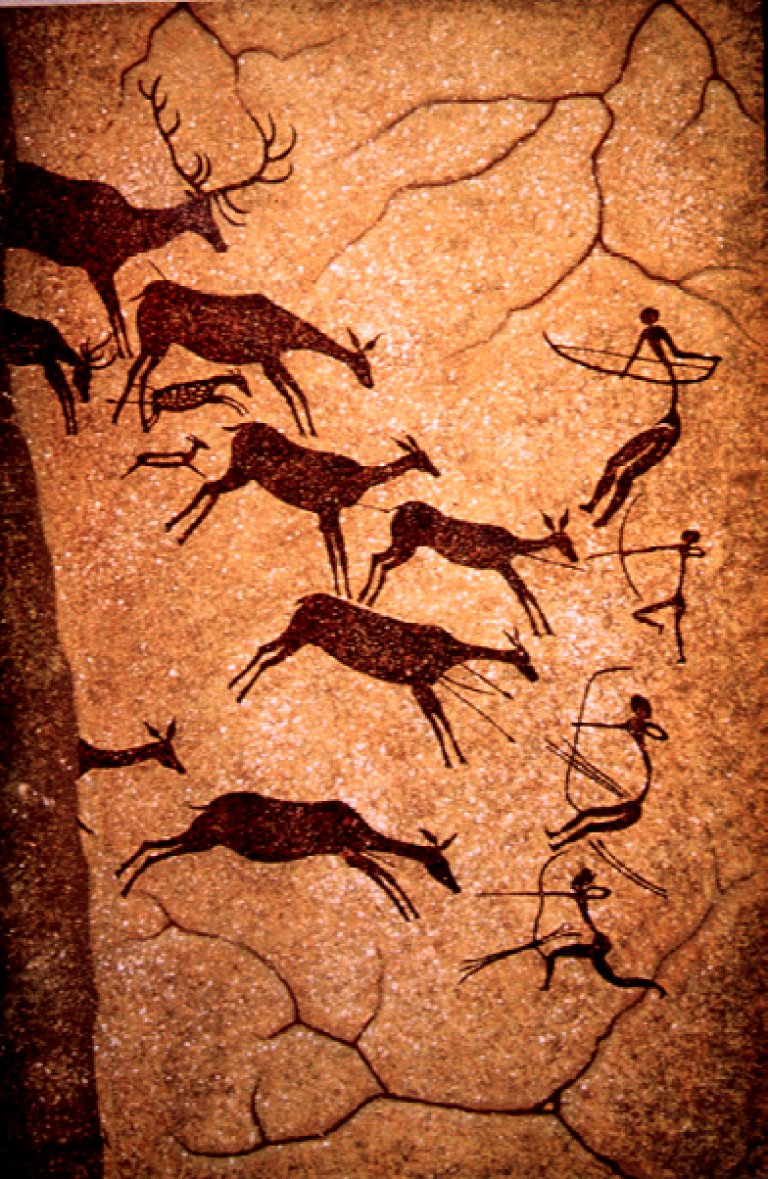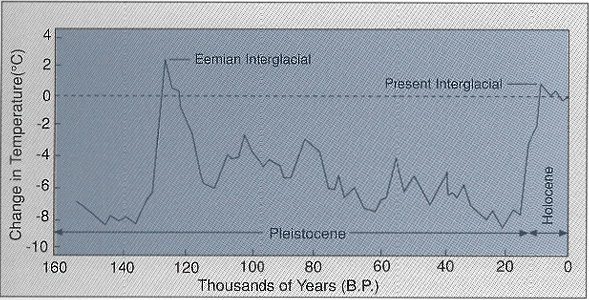
Today we begin our journey to attempt to understand the Universe in which we live. Before we talk about what modern astronomers know, it is important to look back to see where astronomy came from, because much of the language and structure of astronomy owes itself to ancient ideas, beliefs, and traditions. Before we do so, however, you must purge your mind of what you know, or think you know about the Universe. Pretend we are prehistoric cave people. Back some 20,000 years or so, humans were not arranged in complex societies, about the time the last ice age ended:
They basically were "hunter-gatherers". A nomadic lifestyle. We do not know much about their belief systems because they left few traces of their existence, as they rarely stayed in one place long enough to leave a significant record of their presence (though they did leave some traces, such as the cave paintings at Lascaux, dating from 17,000 years ago). Some term them "intelligent animals".
For these people, the Universe was a mysterious place, for they could not comprehend the real reasons why most natural events happened. For example, how do you think they felt during a thunderstorm? Did they do something to bring on such a storm? Even though they did not understand much about the Universe, they certainly soon became aware of certain astronomical events and cycles. Obviously, they knew about night and day. The Sun, whatever it was, would always rise in the East (even though they may not have had a word for East!), travel across the sky, and set in the West. They understood that there then would be a period of darkness before the Sun would again rise.
They certainly also became aware of the Moon and the stars. The Moon would slowly move amongst the stars while constantly changing its appearance. They would probably be able to predict the time of full Moon, as at these times it would be bright enough at night to allow them to hunt (or to be hunted!).
These people might have been aware of the yearly seasonal cycle. There would be times of cold weather, and times of warm weather. Various types of food, such as fruits and vegetables, would be abundant during the warm times of the year. During some times of the year, different types of game animals would be migrating, and they would probably follow them. While we do not have any clear evidence for this type of knowledge among the prehistoric peoples, we know from studying existing tribes of people on this globe that such traditions are still alive and well, and probably remain relatively unchanged in the intervening eons.
For reasons that are not yet completely clear, some 10 to 12 thousand years ago, agriculture appeared on the scene. Various types of animals were domesticated, and humans began to purposely grow food, instead of merely "collecting" it (go here for a recent discovery). Before the development of agriculture, the Universe was more difficult to understand because you would have had to always be "on the move", and it was difficult to recognize the repeated cycles and patterns of celestial motions. There was not much time for reflection. With the rise of agriculture, and we include ranching and fishing in this term, food was not so hard to come by. With experience, you could grow sufficient quantities of grain to get you through the winter. Or you could dry fish and other meats, or use your live animals for food during the winter. Some years you might end up with more of a particular type of food than you needed to survive the winter---you could trade this with a neighbor to get some different type of food. Thus, people were now able to stay in one place, and now could pay more attention to natural cycles. These cycles were especially important for agriculture--you had to know when to plant your seeds, or when to move your sheep to better grazing lands.
The development of agriculture leads to the origin of astronomy. For example, you would quickly notice harbingers of the coming spring by watching the motion of the Sun and stars. Fisherman would notice how the movements of the Moon would affect the tides. With sufficient observation you would notice that there was a predictable pattern: a certain number of days would have to elapse between when the Sun would again rise at a particular spot on your horizon. You would develop a system that would allow you to predict when it was time to plant your grain. You would devise a calendar. The beginning of each new cycle may have been cause for a celebration---the first "New Year's" celebrations.
Of course, it became quite clear that just because it was officially "spring", it did not mean it was warm enough to plant your grain. The weather was only partially tied to the motion of the Sun in the sky--some years were good, some years were bad. A bad year might lead you to suspect that you had done something to upset nature, you may have angered the Sun for example. It is not too hard to envision the early rise of religion to attempt to understand these events, and with that, various ceremonies designed to placate these celestial beings. With these developments, we get a new type of profession: the priest. A person who's sole job it was to understand and read the signs of nature, and to keep accurate track of time so that all of the necessary ceremonies occurred on schedule to keep the gods happy. Of course, it was also the priest's job to suggest remedies when things went unexpectantly wrong.
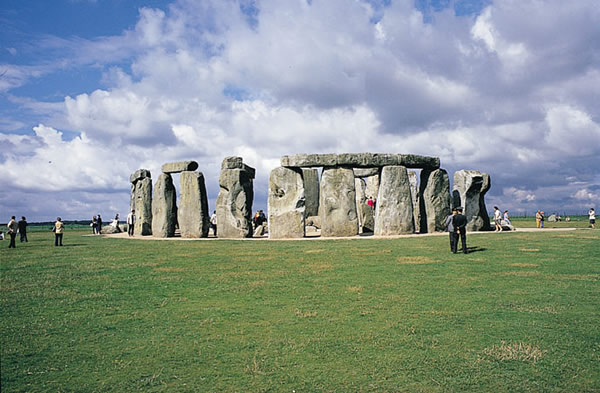
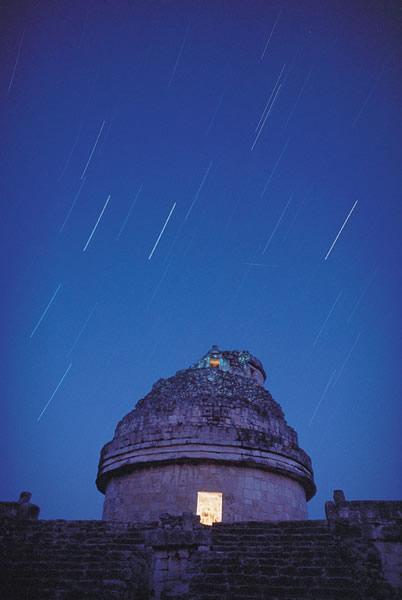
With the rise of priests came more careful observation of natural cycles. The earliest records of "calendars" appear to be various alignments of stones, and of pre-historic buildings. Most of these are of the "horizon-intercept" kind, they were aligned with where the Sun (or Moon) rose (or set) along the local horizon. One example you are almost certainly familiar with is Stonehenge. Activity at the site of Stonehenge appears to date back to 7,000 BC, but the construction of the main parts of the monument appear to have begun around 3,000 BC. The various structures we see today at Stonehenge appear to be carefully aligned with the horizon locations ("azimuths") of the risings and settings of the Sun and Moon at various extremes in their motion (furthest south, furthest north, etc.). During this time, similar structures were being constructed elsewhere in the world, in both the Middle East (Babylon and Egypt), and in the far east (India and China). Later, such structures arose with the Mayan/Aztec culture in the Americas (reaching their peak circa 200 AD, though archeological evidence suggests their culture began about 1500 years before it reached its peak).
The first actual "calendars", as we would recognize them, appeared on the scene about 6,000 years ago (go here for more on the Egyptian calendar). The Chinese calendar appears to have begun in 2637 BC (go here for more on Chinese calendars), while the Egyptian calendar (from which our modern calendar arose) appears to date from 4236 BC! These calendars even had systems to account for the fact that the year is not exactly 365 days long (why we have "leap" years).
As observations became more careful and accurate, cycles were noticed, as well as other phenomena: the discovery of the planets, and their motions. The appearance of comets, and "new stars" were noted. Of course, to keep track of all of this, writing had to be developed, as well as mathematics! With these developments, ancient cultures were able to predict astronomical motions and events well into the future---the most extreme case probably occurred in Mayan culture, with some events recurring on cycles that had periods of 3 million years!
Thus, its pretty clear that the origin of astronomy (and science in general) can be traced back to the rise of agriculture.
Let us look more closely at the ties between astronomical
events and agriculture.
One of the most important dates for any farmer is the time of year that is
best suited for planting their crops. If you plant your seeds when it is still
too cold outside, it is likely that the seed will rot, and you will not
get a very good crop of grain. If you wait too long, until the weather is
hot, you also might get a very poor sprout rate because it is now too dry
for your seeds to germinate (more mature plants are better at seeking water
than little seedlings). In warmer areas, it is the coming of the rainy season
that is more important than other factors, as they rarely have killing frosts
in tropical and sub-tropical regions. It would be of great value if you knew
how to predict the rainy season.
Thus, early farmers were keen skywatchers and observers of nature's cycles.
One example from our text book is shown here:
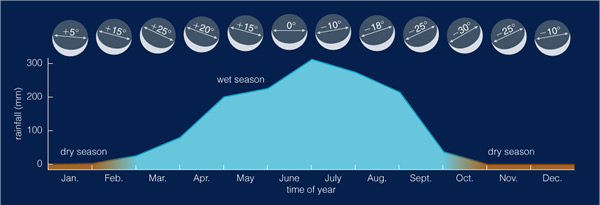
A carved bone from central Africa dating to 6500 BC showing pictographs of the crescent Moon. They observed that the crescent Moon, when it was close to setting on the western horizon, had different orientations throughout the year. And during those times of the year when it set so that the crescent set oriented exactly on the horizon (the two "horns" of the crescent set at the same time), the rainy season would be near its mid-point. Therefore, they could watch how the setting crescent Moon progressed over the year, and have a good indication of when the rainy season would begin--the time to plant your seeds.
Another example that you may have heard of is that of the ancient Egyptians and the flooding of the Nile. Every summer, the Nile river in Egypt begins its annual flooding. When the river was high, they could irrigate their crops and begin their farming season. Unbeknownst to the early Egyptians, the reason the Nile flooded at this time of year was that heavy rains in Central Africa fell every June and July. The Egyptians noticed that the flooding of the Nile corresponded to the appearance of the star Sirius (the brightest star in the nightime sky) rising in the Eastern sky just before the Sun--after being invisible for several months. They used this rising to portend the coming floods, and developed a calendar to help them predict the annual flood. The start of this calendar was based on the regular appearance of Sirius in late July each year.
Sirius is a real beacon, it is the brightest star in the sky, and only is exceeded by the Sun, the Moon, and the planets Venus and Jupiter in brightness. In fact, the Egyptians believed that summer was hot because the star Sirius and the Sun were lined-up, and their combined heat intensified that of the Sun alone. The star Sirius is in the constellation of Canis Major, the "great dog". This is also why Sirius is sometimes referred to as the "dog star", and why we have the "dog days of summer". A 5,000 year old tradition that has made it to modern times.
Speaking of constellations, groups of stars for which ancient people constructed mythologies (stories), the Egyptians had only about one dozen. To the ancient Egyptians, most heavenly bodies (besides the Sun and Moon) were just not very important to them. One of the most important of their constellations, however, was the one we call Orion. The Egyptians called this constellation "Osiris", the "God of Light". The mythology of the constellation of Orion/Osiris can be found here, where you will find a set of sky charts for each month. The constellation of Orion is highlighted for the month of February. In January and February Orion is visible in the southeast right after sunset. By 9pm, during those months it is high in the sky towards the south, and Sirius will be below, and left (southeast) of Orion (the belt of Orion points to Sirius). To see Orion during the Fall semster requires you to go out very early in the morning (before sunrise in September). By December it rises at sunset.
Most of the other constellations in the sky come down to us from the Greeks and Romans. The mythologies of these constellations are usually tied to the Greco-Roman gods and/or their heroes. Some of the stories go further back than the Greeks. One of these is the mythology of Perseus (the constellation highlight for December). You can read about the mythology at the link mentioned above, along with that of the associated costellations of Andromeda, Pegasus, Cepheus, Cassiopeia, and Cetus. Perseus is famous for slewing the Medusa (for a more complete version of the story, go here), who's gaze could turn you into stone. The Greek mythology for Perseus is at least 2,500 years old, but the story has more ancient roots, possibly going as far back as 4,000 yrs ago, back to Babylonian/Sumerian times by linkage to the ancient hero Gilgamesh (go here for an interesting take on the epic of Gilgamesh).
With more freedom of time afforded by agriculture, people had more time to devote to skywatching. This allowed for a rich history of stories about the origin of the constellations as well as assigning them various "powers". For if a star like Sirius could cause the Nile to flood, why wouldn't the position of the Sun or Moon in some constellation predict some other event equally important to humans (like the birth or death of kings)? Besides the Sun, Moon, and stars, the ancients were aware of five other objects that moved against the sky: the planets. Each planet had its own peculiar motion. The planet Mercury moved through the sky very quickly, and was always located close to the Sun. While Jupiter, the king of the Gods, moved at a more leisurely pace (completing one circuit of the sky in 13 years).
It did not take too long before the association of the planet with one or more gods lead to predictions about what the movement of a particular planet meant in terms of human beings. This is the subject of Astrology. Astrology is the prediction of various human traits or events to individuals depending on where the planets, Sun and Moon are in the sky at the time of their birth. Given your astrological classification, then the movement of these objects through time can then be used to forecast events in your life.
Astrology is called a pseudoscience, as it uses elements of science (such as the real motions of planets among the stars) to make predictions that are too general to be tested in a scientific way. For example, today your horoscope may say "today is a good day to make new friends". How do you quantify this? When is it a bad day to make new friends?
Astrology is relatively harmless if you do not take it too seriously. But would you want your surgeon to decide to postpone an important operation because Mars was in Aquarius? Or start a war because the stars tell the President it is the right time to do so? Astronomers have to spend time debunking astrology because the general public confuses it with what they do. Astronomy is a real science, it follows something called the scientific method.
1) Make an observation (or set of observations) about some aspect of our universe.
2) Propose a tentative explanation, called a hypothesis, that appears to be consistent with the observations you have made.
3) Use your hypothesis to make predictions about this particular phenomenon.
4) Test the predictions by conducting specific experiments to test this hypothesis in every conceivable way (or make additional observations that allow you to confirm your predictions-since not every target for observation can be actively experimented on!).
5) Examine if your hypothesis explains all of the observations. If it does not, modify the original hypothesis if possible, or go back to step #2 and start again.
6) If your hypothesis passes all conceivable tests, than it becomes a "Theory". Note that scientists use theory differently from everyone else. For us, a "Theory" is the culmination of our experiments--we have no doubts that it correctly explains all of the current information. Thus, when a scientist says "theory" they mean that it is basically a "law", it is how nature operates. The lay public thinks the word theory means there is room for doubt. That is why you sometimes see these arguments about the "Theory of Evolution". Scientists have no doubt that Evolution correctly describes nature, but laypeople believe the word theory means that Evolution is only a "guess" on how nature operates. (It would probably be better if scientists used phrases like "The Natural Law of Evolution".)
We will talk some more about the rise of modern science and the scientific method during the next class. This will lead to the first treatment of the celestial objects as physical objects, and not metaphysical objects.