
and the estimated uncertainties in these magnitudes, assuming that the background is measured exactly.
Use the following


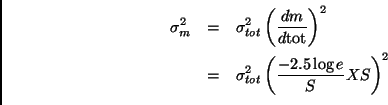
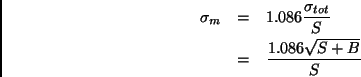
This gives
| S | B | S/N | m |  |
| 10 | 0 | 3.16 | -2.5 | 0.34 |
| 10 | 100 | 0.95 | -2.5 | 1.14 |
| 100 | 0 | 10 | -5 | 0.1 |
| 100 | 100 | 7.07 | -5 | 0.15 |
We wish to get the mean count rate  :
:


However, we can only estimate
 , because it depends on ,

where
 is the number of pixels over which we are summing. Clearly,
the 3 different measurements have different S/N, so we want to use a weighted
mean to get the best estimate of the count rate. To avoid biases, we want to
use the correct relative weights, at least. To do so, we make some estimate
of the mean count rate, then use this estimate to get the correct relative
weights. It doesn't really matter how we get our initial estimate of ;
once the relative weights are correct, the resulting bias will be negligible.
So let's just take the rate from the highest S/N exposure as our estimate
is the number of pixels over which we are summing. Clearly,
the 3 different measurements have different S/N, so we want to use a weighted
mean to get the best estimate of the count rate. To avoid biases, we want to
use the correct relative weights, at least. To do so, we make some estimate
of the mean count rate, then use this estimate to get the correct relative
weights. It doesn't really matter how we get our initial estimate of ;
once the relative weights are correct, the resulting bias will be negligible.
So let's just take the rate from the highest S/N exposure as our estimate
 . Then, we have:

where

Using
 ,
,
 , we get:


So,
 means that the ratio of B band light to V band
light is 2.512 times
larger in the star than in Vega, i.e. the star is redder. The key point here
is that it is the color relative to Vega.
means that the ratio of B band light to V band
light is 2.512 times
larger in the star than in Vega, i.e. the star is redder. The key point here
is that it is the color relative to Vega.

where
 gives the efficiency of telescope and detector (0.5) and
  is
the filter transmission. For a rectangular bandpass,
is
the filter transmission. For a rectangular bandpass,

Signal from star is given by
 .
Background is given by
.
Background is given by
 ,
where
,
where  is the area of the sky over which you integrate your measurement.
For FWHM of 2 arcseconds, I'd say
is the area of the sky over which you integrate your measurement.
For FWHM of 2 arcseconds, I'd say
 .
.

Thus, to get S/N=10, you would need
 26,000 seconds!
If the image quality were 0.8 arcsec, the background counts go down,
and the exposure time is shortened to about 4000 sec.
26,000 seconds!
If the image quality were 0.8 arcsec, the background counts go down,
and the exposure time is shortened to about 4000 sec.