Objects with different masses have different escape velocities. For an object with mass M and radius R,
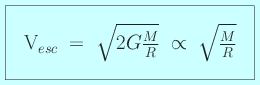
|
where G is a constant related to gravity.
It makes sense that escape velocity increases as an object's mass gets larger. (It takes more energy to escape from a more massive object and its stronger gravitational attraction.) The escape velocity is also higher for objects which are smaller. If you are trapped on the surface, then the smaller the object is the closer you are to all of that mass (and the harder it is to pull away from it).
- The Earth has an escape velocity of 11 kilometers per second.
- The Sun has an escape velocity of 618 kilometers per second, 56 times larger than that of the Earth.
- For a dense neutron star, the escape velocity is enormous – 60% of the speed of light!
- What happens when the object becomes more dense than a neutron star, and the escape velocity approaches or exceeds the speed of light?