|
| [NMSU, N. Vogt] |
If a wave is moving with respect to an observer (either toward or away from them), the observed frequency and wavelength of the wave will appear to change. We call this a Doppler shift. This effect can occur with both sound and light, because both sound and light demonstrate wave-like behavior.
What are some common examples of Doppler shifts?
|
|
| [NMSU, N. Vogt] |
Stationary Sound Source
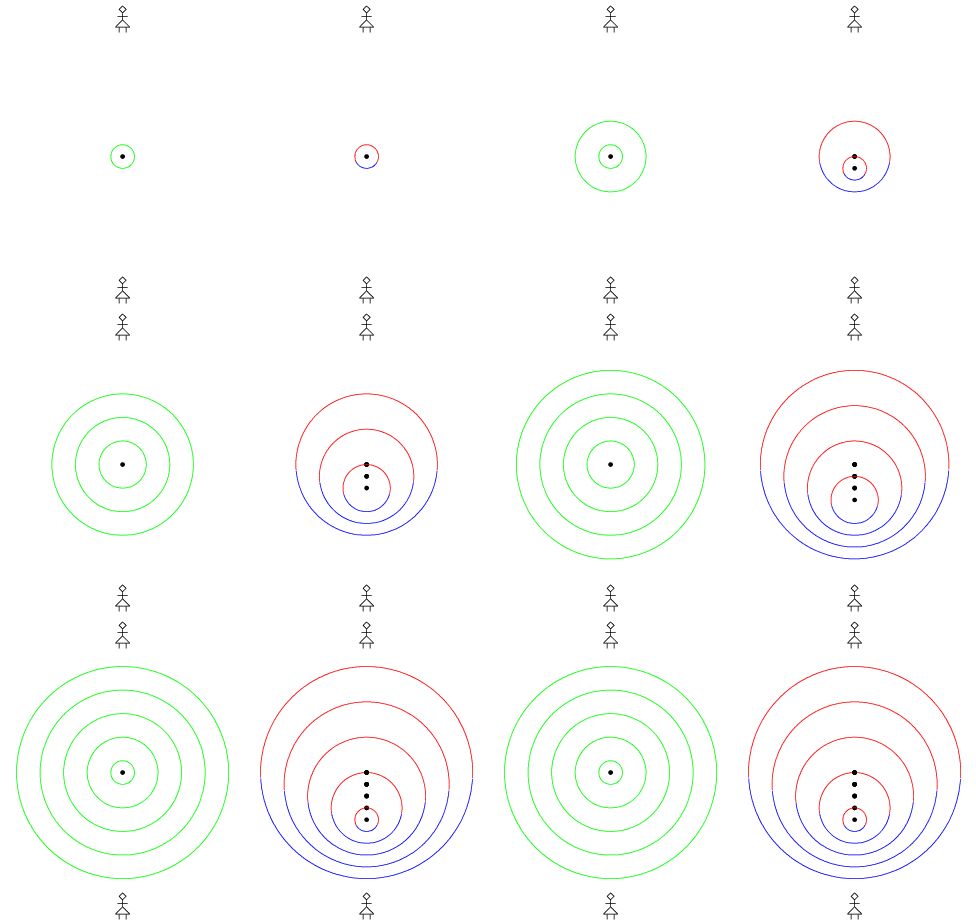
The figure on the left shows a stationary sound source, like a smoke
alarm blaring out sound waves. Compare it to the way that
ripples spread outward on the surface of a very still pond, when you toss in
a pebble. Sound waves are produced at a constant frequency, and the
wavefronts (successive wave peaks) propagate symmetrically away from the
source at a constant speed (the speed of sound in the medium). The distance
between wavefronts is equal to the wavelength. All observers will hear the
same frequency, which will be equal to the actual frequency of the source.
Moving Sound Source
The figure on the right shows the same sound source, still radiating
sound waves at a constant frequency in the same medium. Now, however, the
sound source is moving downward. The wavefronts are produced with
the same frequency as before. Since the source is moving, the center of each
new wavefront is now slightly displaced downward. As a result, the
wavefronts begin to bunch up on the bottom side (in front of the source) and
spread further apart on the top side (behind the source). An observer in
front of the source (below) will hear a higher frequency, and an
observer behind the source (above) will hear a lower frequency sound.
The sound will not appear to have changed frequencies, to a hitchhiker
traveling along with the sound source.
Imagine a similar example from daily life, such as listening to the sound of an an approaching train. The sound waves coming from the engine are squeezed closer together than they would be if the train were still. This happens because the train is moving in your direction. This shortening of the waves increases the number of waves (the frequency) that reach your ear every second. But after the noise of the train's engine passes, the frequency diminishes. The sound waves are now stretched apart by the train's movement in the opposite direction. As an observer, you perceive these frequency changes as shifts in the pitch of the sound. The pitch is higher as the train approaches, and lower as it travels away.
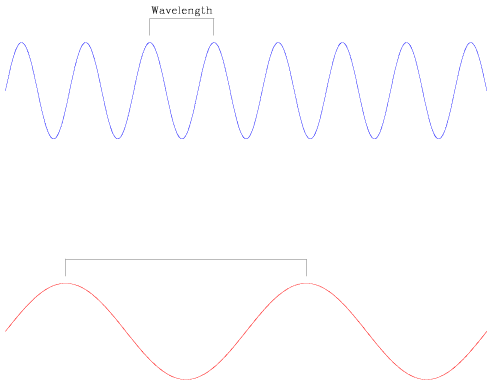
We characterize light by its frequency, or wavelength (the distance between successive beats, or until the pattern of the wave repeats itself, literally, the length of the wave). As shown below, blue light has a short wavelength, while red light has a longer wavelength.
|
| [NMSU, N. Vogt] |
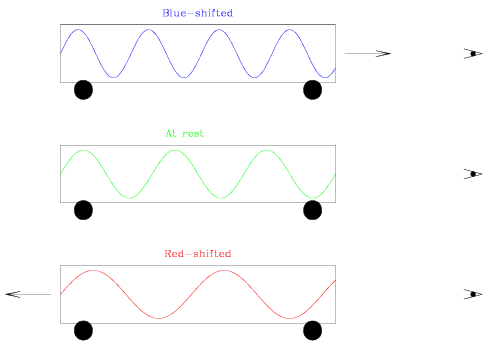
When a star or galaxy is moving towards us, the wavelength of the light becomes shorter, and we say that it is blue-shifted. When it is moving away from us, the light is shifted towards longer wavelengths, and we say that it is red-shifted.
|
| [NMSU, N. Vogt] |
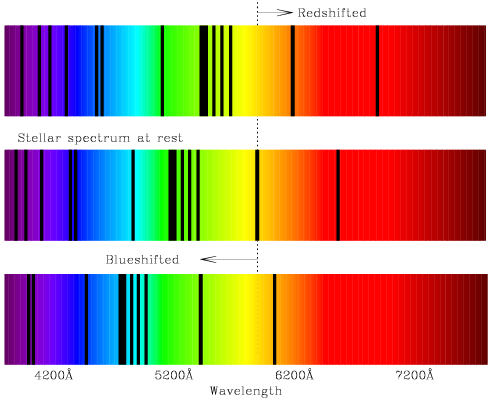
If the distance between a star and Earth is increasing, the spectral lines in the absorption or emission spectrum will shift slightly to the lower frequency, or red portion of the spectrum. If the distance is decreasing, the lines will shift toward the blue portion. The image below shows a simplified star spectrum with red and blue-shifts. Notice how the entire spectra gets shifted to the blue (left) or red (right).
|
| [NMSU, N. Vogt] |