Greek model: The word atom designated the smallest possible
piece of matter that could exist, small spheres which were indivisible in
nature. Atoms could be made up of any one of the four elements (earth, water,
fire, air), and combined to form everything in the Universe. No one could
actually see such a small structure, so atomic structure was based on indirect
and philosophical arguments.
The Greek model worked well enough throughout most of history. By the
beginning of the 20th century, however, experimental physics and
chemistry revealed some intriguing complications which called for a more
sophisticated model of the atom ...
There were at least seventy different types of atoms (the periodic table
elements).
Atoms and the electromagnetic spectrum were linked: atoms emitted and
absorbed light, and could be distinguished by their spectra (the pattern of
emitted and absorbed light of different frequencies).
There was evidence for internal structure in atoms, in the
specific, unchanging frequencies of emitted and absorbed light for different
atoms.
There was evidence for substructure in atoms, in the discovery of
the electron, and in x-rays and the new field of radioactivity (which showed that subatomic particles
might be emitted from atoms).
Atomic theory advanced rapidly through the 20th century, as
scientists explored the properties of atoms. A series of models were
proposed, each in turn building on the success of the former.
Thomson's Model
Rutherford's Model
Bohr's Model
The Electron Cloud Model
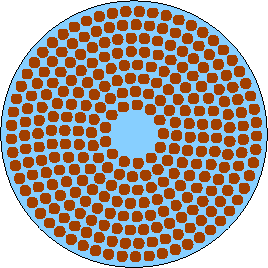
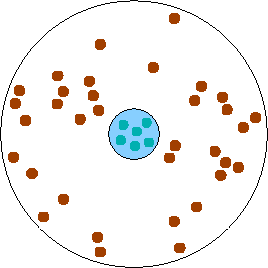
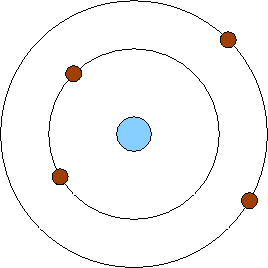
Atomic models, with negatively charged electrons
shown in brown, and positively charged
particles (or the nucleus) shown in blue.
[NMSU, N. Vogt]
Thomson's model (the plum pudding):Joseph John Thomson, the discoverer of the electron,
proposed that positive charges were spread uniformly throughout a sphere (the
atom), while negative charges (electrons) were embedded throughout the uniform
background. In this model all of the mass of the atom was provided by
electrons, which meant that (1) most atoms would have to contain thousands of
electrons, and (2) the difference between two elements would be not one
electron, but many.
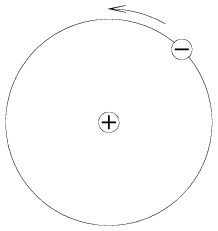
Rutherford's model:Ernest Rutherford
tested Thomson's model of the atom by firing alpha particles (the nucleus of a
helium atom, comprised of two neutrons and two protons) at atoms, and
measuring their deflection. Thomson's model predicted that the alpha
particles would pass uniformly through the atom, but the experiment showed
that some particles passed through the atom without altering their
paths but others were deflected (their trajectories changed). Rutherford
concluded that atoms had a central core, the nucleus, which contained
the positive charges, around which the electrons orbited. (Note the
superficial resemblance to the planets orbiting the Sun!) The alpha particles
could either pass freely through the relatively empty outer regions of the
atom, or pass too near to the nucleus and interact with it.
Bohr's model:Niels Bohr pointed out that as electrons held a charge,
if they orbited around the nucleus of an atom they should be in a state of
acceleration and thus radiate energy. There should be two observable effects:
As the electron loses energy, it should move into a lower energy orbit (at a
lower radius). The energy radiated by the electron is dependent upon the
energy of the orbit (proportional to its acceleration), so as the electron
moves into a lower orbit it should radiate smaller packets (a lower frequency)
of energy.
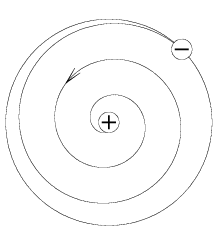
The electron should continually radiate energy, and drop into lower energy
orbits. Over time, it should spiral into the nucleus and be subsumed.
*** Atoms were observed to emit radiation only at
specific, well-defined and well-separated frequencies, and electrons appeared
to be in stable, non-decaying orbits. ***
*** Atoms radiated energy at specific frequencies,
but the pattern of those frequencies was not understood. They were not
related by any known physical mechanism, such as octaves or overtones are
related for musical tones. *** (Recall that sounds can be characterized
by their frequencies, just as we characterize atomic spectra by their (somewhat
higher) frequencies.)
Rutherford's electron, decaying on a steady, deadly inward spiral of doom.
Electrons exist in certain stationary states within atoms. These
states are each defined by a discrete, unique level of energy. Only certain
energy levels, like orbits with certain radii, are allowed; states in between
allowed levels simply don't exist. They differ from classical states
(analogous to those occupied by the planets in orbit) in that the accelerated
electron does not continuously radiate energy.
The atom will emit or absorb energy when an electron shifts from one
stationary state to another. The frequency of the radiation will be
proportional to the difference in the energy levels between the two states.
We say that the energy, E (measured in ergs), is the product of the frequency,
v (measured in cycles per second), and a constant (Planck's constant, h
= 6.57 × 10 erg-sec) as follows:
E = h × v
We can express the energy either by its frequency, v, or by its
wavelength, l (measured in units of length). Frequency and wavelength
are inversely proportional, and can be expressed according to the speed of
light as follows:
v = c / l
Thus if we express c in units of meters per second, and wavelength l in
units of meters, we determine the frequency v in units of cycles per
second. If you have a large amount of energy, you can say that your
particle is at a high frequency or a short wavelength. If you
have a small amount of energy, you can say that your particle is at a
low frequency or a long wavelength.
E = h × v = h × c / l
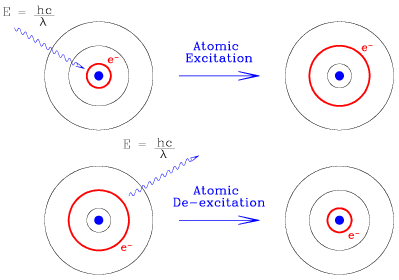
[1] An atom absorbs radiation, and an electron shifts from a lower energy level to a higher one.
[2] An atom emits radiation, and an electron drops from a higher energy level to a lower one.
[NMSU, N. Vogt]
In each case shown above the wavelength of the emitted or absorbed radiation
is exactly such that the photon carries the energy difference between the two
energy levels. The atom can absorb or emit only certain discrete wavelengths
(or equivalently, frequencies or energies).
Classical theory can explain the properties of the atom while the electrons
are held in a stationary state, but cannot explain the way that they shift from
one energy level to another.
The kinetic energy of the atom can be expressed in terms of the angular
frequency of rotation of the electrons in their orbits. If the electrons
travel on circular orbits, then this energy can be expressed as integral
multiples of h/2. We say that this energy is quantized, because it is
emitted only at a few select, set frequencies.
The structure of the atom was an integral puzzle in the development of
quantum mechanics.
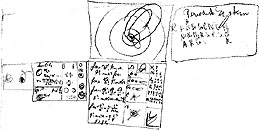
Niels Bohr's scribbled research notes for his new model of the atom -
great science is rarely clean and beautiful upon conception, but
rather messy and inspired by fevered haste!
Electron cloud model:
Bohr's model represented a fantastic leap of intuition. Over the next few
decades the quantum model would be refined and further developed, to better
explain the more complicated energy levels of atoms which contain multiple
electrons and the bonds between atoms which combine to form molecules.
The idea of spin was introduced, to distinguish between two electrons
which lie at the same energy level within an atom.
The theory of relativity was seen to affect the path of electrons, due to
their immense speeds.
We no longer visualize electrons as solid, spherical particles which orbit
around the nucleus of the atom. Instead, we say that an electron can be
thought of as a dispersed structure (similar to a cloud) which occupies a
region of the atom defined by a certain energy level. The electron is not
found in a single place within the atom, but rather has a probability
function which governs how likely it is that it is to be at any particular
location. If you add up the probabilities across the entire atom, they sum to
one. (Sound wild? Consider Richard Feynman's idea that perhaps there is
only one single electron in the universe, which simultaneously occupies
all atoms at all times.)


 erg-sec) as follows: