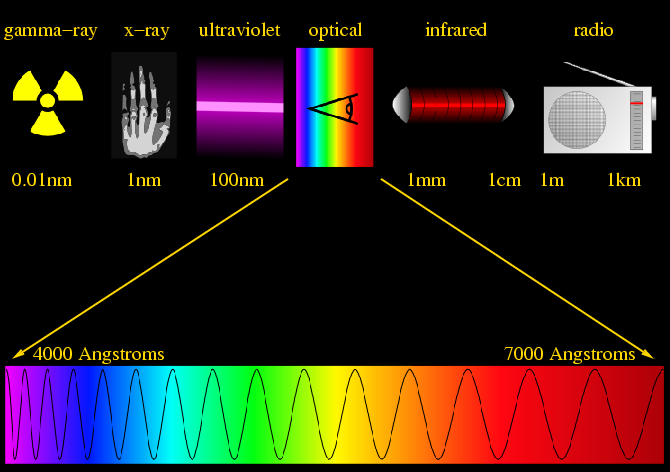
Light, or radiation, can be thought of as a wave. As we shift across the
electromagnetic spectrum, we find light of many wavelengths. Gamma-rays, x-rays,
and ultraviolet radiation are all forms of light with a great deal of energy,
and shorter wavelengths than those that we can detect with our eyes. The
intermediate wavelengths (4000 to 7500 Angstroms) are the wavelengths of visual
light, followed by infrared (heat), radio, and even gravitational radiation.
The defining characteristics of waves are that they are periodic
(the pattern repeats), and they have a certain amplitude (the height of
the pattern) and frequency/wavelength (the number of times the patter
is repeated per unit time/the spatial length of the pattern). Think about an
example of waves in our daily lives, such as sound waves (density or
pressure waves) from musical instruments, waves passing along a slinky
or a jump rope (transverse waves), or ocean waves (gravity or
surface waves).
When you blow along the edge of a bottle, you create a deep, resonant
sound (like a foghorn). If you change the length of the bottle, either by
getting a shorter/longer bottle or by filling your original bottle with water,
you can change the pitch of the sound. This is the principle behind musical
instruments.
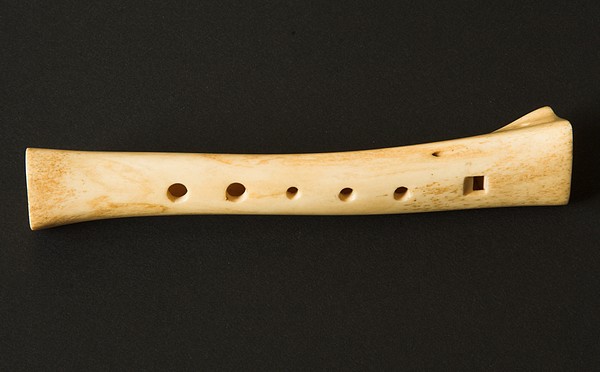
Short instruments (like a flute) produce high pitched, high frequency
sound waves. The flautist changes the pitch of the sound by opening or
closing off holes along the length of the flute, making it into a pipe which
is shorter (high pitches) or longer (low pitches).
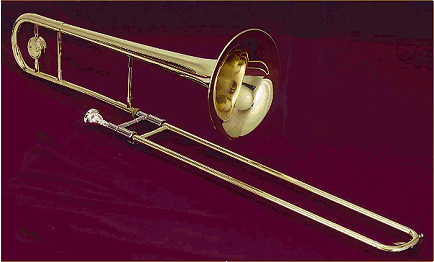
Longer instruments, like a trombone, produce low pitched, deep, low
frequency sound waves. The trombonist changes the pitch of the sound by
contracting or extending the slide, an extra tube within the body of the
instrument, making it into a tube which is shorter (high pitches) or longer
(low pitches).
Consider the following thought experiment. A musician changes the pitch
of sounds to create music. In a simple case, a guitarist moves his finger
along the length of a guitar string to change the frequency (pitch) of the
music. As his finger moves closer and closer to one end of the string, the
frequency of the sound wave rises. Now imagine that he moves his finger
extremely close to one end of the string, so close that the resulting
frequency moves out of the regime of sound waves ... and into the regime of
visual light (higher frequencies). In a metaphorical fashion, the musician
could transform sound into light!
The speed of sound in air (on a cool day) is ~1000 feet/second. (In
comparison, the speed of light is 186,000 miles/second. This is how you can
estimate how far away lightning strikes are, by counting the time between
seeing the lightning strike and hearing the thunder reach you.)
Do the air molecules travel at this speed? In a higher-density medium (for
example, railway tracks) a sound wave travels faster. In a lower-density
medium, it is harder to transmit sound, and it travels slower. How does this
affect astronauts doing walk-about missions in space – can they talk to
each other easily?
If you hold a slinky between your hands, with your hands far apart from
each other, you can pass a low frequency, low energy wave along its surface.
You are not actually moving the entire slinky from hand to hand; instead, a
wave shape passes along the body of the slinky as you shake it gently.
As you shake the slinky faster, putting more energy into the system, you can
increase the frequency of the wave that you create (the pulses are closer
together).
Resonance: A system can build up enormous amounts of energy, if
you drive it at the resonant frequency. Think about pushing a toddler on a
swing at the park; she swings back and forth, back and forth, and needs
constant pushing or she will slowly lose energy and the swing will stop. If
you push inefficiently, at a random point in her path or not always in the
direction of motion, you will work hard, occasionally get hit in the head by a
loose shoe, and she will not swing very fast. If you always push her at one
peak of her path, and always push in the direction of travel, you will be
driving the swing at resonance and she will swing pretty quickly –
perhaps fast enough to fly over the supporting bar!
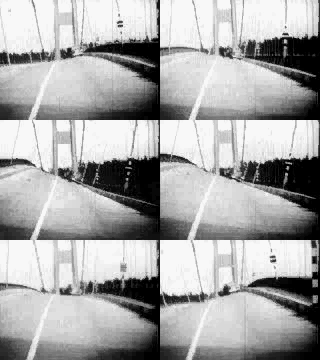
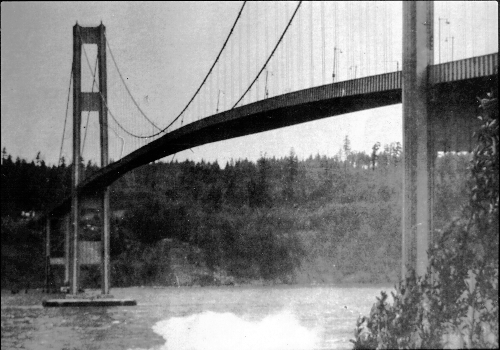
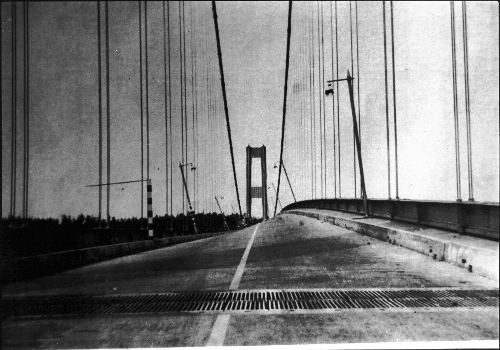
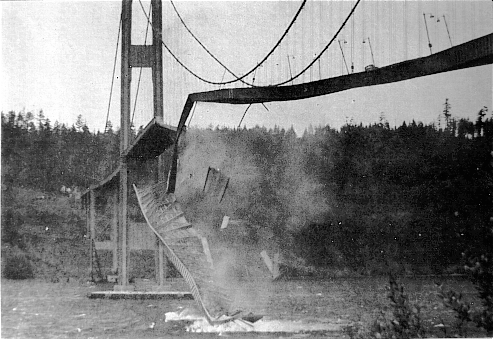
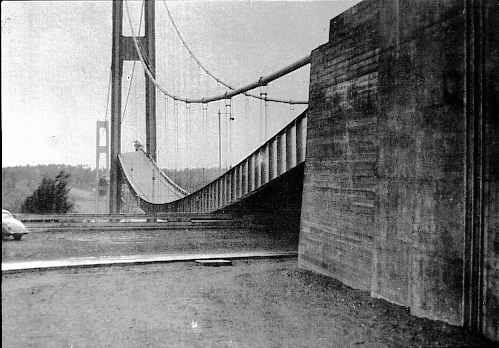
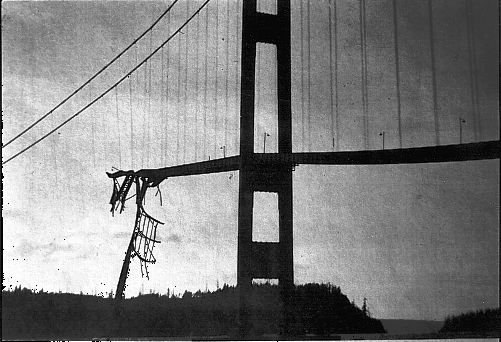
Have you heard of the 1940 Tacoma Narrows Bridge disaster? What role did waves
play in amplifying the resonant effect of the 40 mph winds on the bridge, and
shaking it apart?
Just as I drove past the towers, the bridge began to sway violently from
side to side. Before I realized it, the tilt became so violent that I lost
control of the car. I jammed on the brakes and got out, only to be thrown
onto my face against the curb. Around me I could hear concrete cracking. I
started to get my dog Tubby, but was thrown again before I could reach the
car. The car itself began to slide from side to side of the roadway. On
hands and knees most of the time, I crawled 500 yards or more to the towers.
My breath was coming in gasps; my knees were raw and bleeding, my hands
bruised and swollen from gripping the concrete curb. Toward the last, I
risked rising to my feet and running a few yards at a time. Safely back at
the toll plaza, I saw the bridge in its final collapse and saw my car plunge
into the Narrows. – Leonard Coatsworth, involuntary eye-witness
Twisting
Tilting
Warping
Sagging
Aftermath
The stress modes imposed on the Tacoma Narrows Bridge in 1940.
[M. Ketchum]
We understand more about the dangers of resonant effects today than in
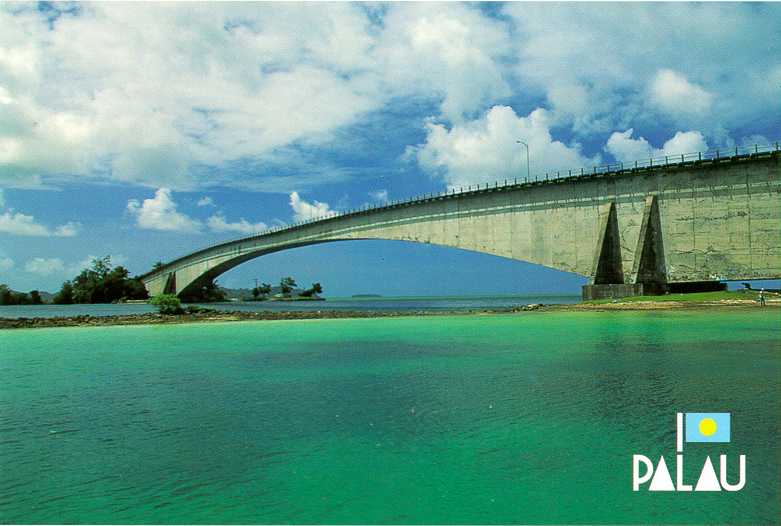
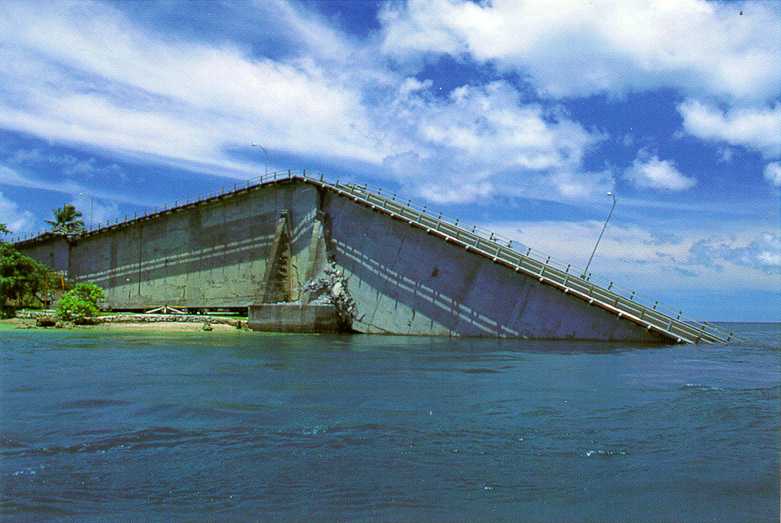
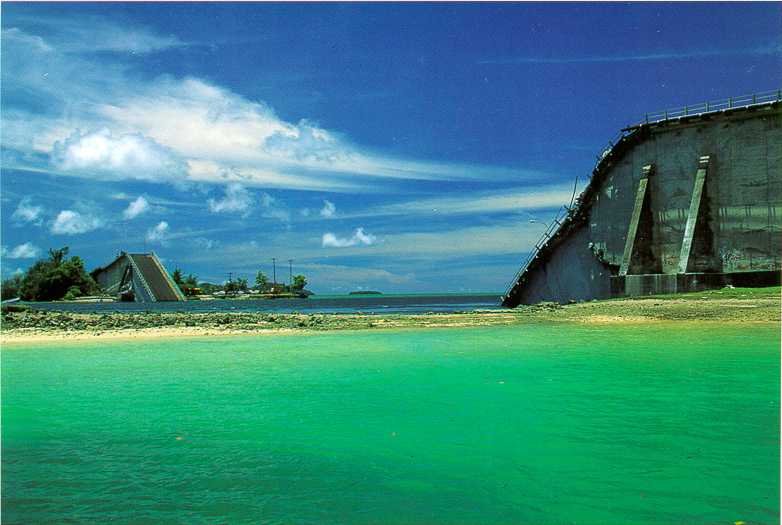
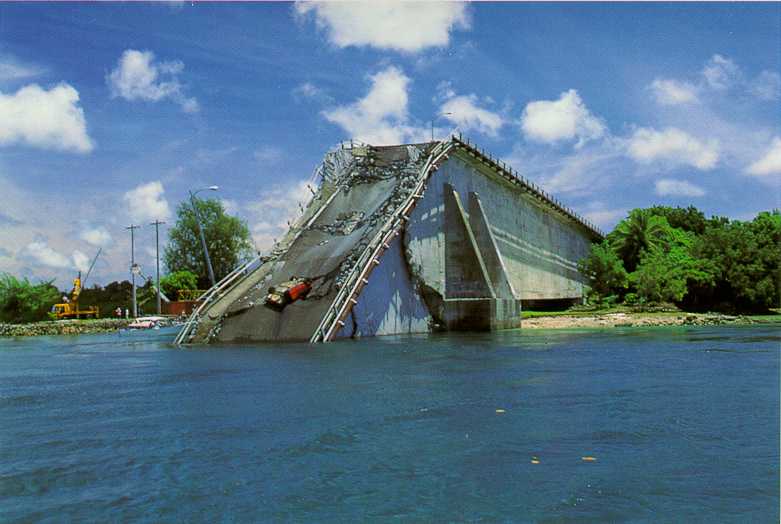
the past. But consider the Koror-Babeldaob Bridge, 800 feet in length, which
collapsed suddenly one evening in 1996 after bearing loads without signs of
trouble for almost thirty years.
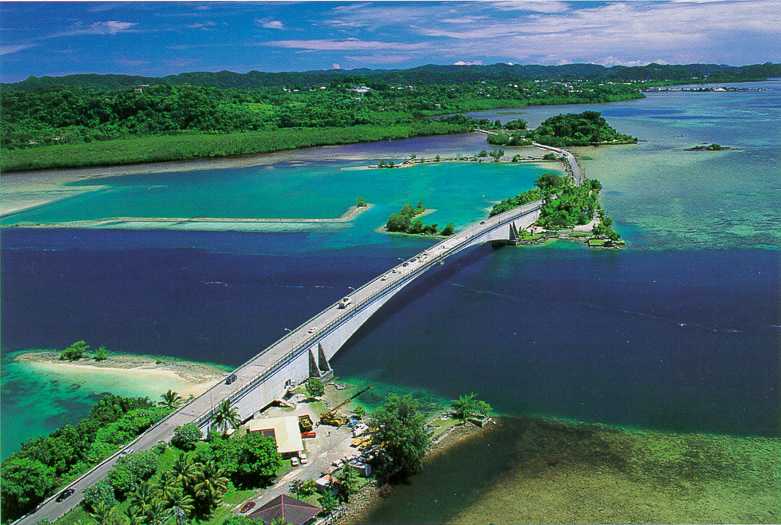
Palau [an archipelago located midway between Japan and Australia] is very
small. A single road connects the four islands that host most of the country's
17,000 people. Between three of the islands there are raised concrete
causeways; the largest island, Babeldaob, connects to Koror, the capital, by a
bridge. Until recently at least. In September, 1996, the bridge – an
800-foot concrete span – fell into the channel. When I asked a local
woman what had happened to it she said, It collapse. Earthquake? I
asked. No, just collapse, she said, as though these things just happen
sometimes. – American visitor.
The Palau concrete bridge, before (top row) and then after (bottom row) the 1996 disaster.
[M. Ketchum]