
|
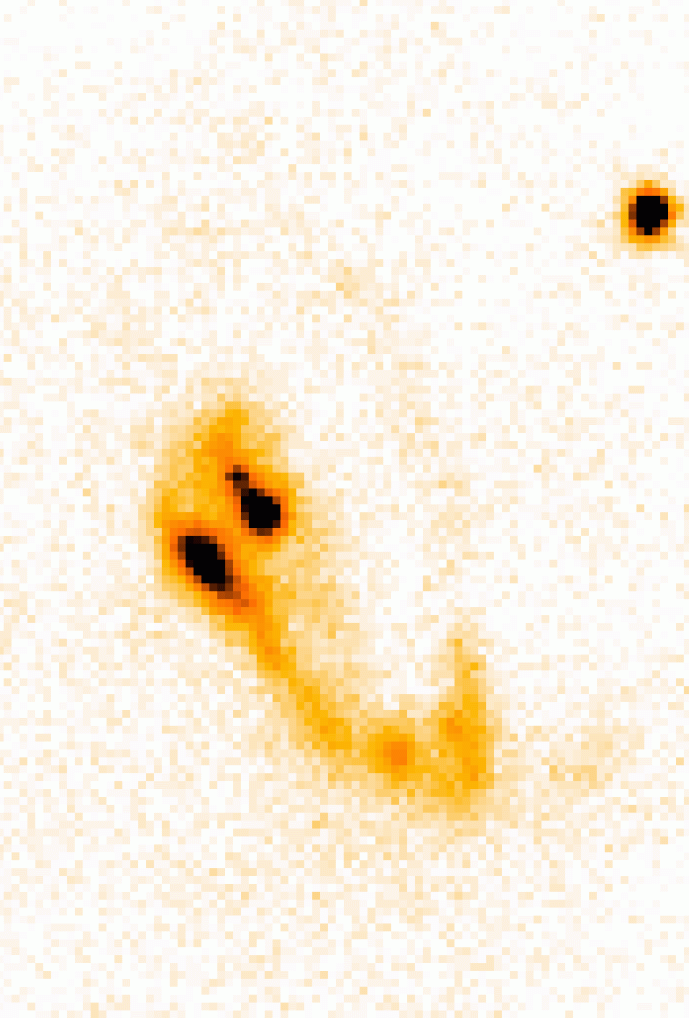
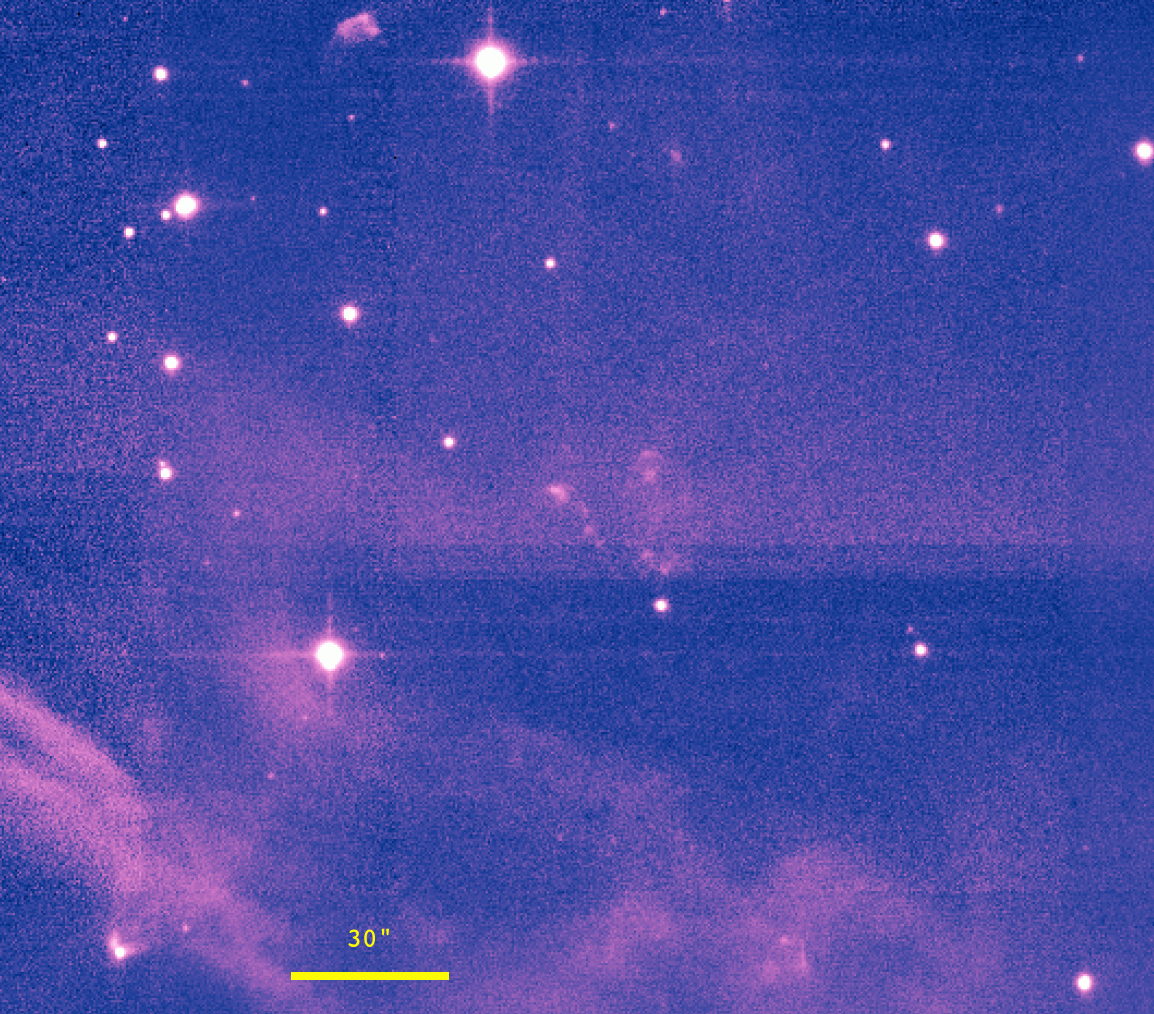
For my M.Sc. thesis at Saint Mary's University, I used the Canada-France-Hawaii Telescope (CFHT) with Dr. George Mitchell to image star forming regions in the Orion B Molecular Cloud. SCUBA mapping of Orion B (Mitchell et al. 2001, ApJ 556, 215) has revealed a large population of compact cores. With the CFHT-IR camera, we looked at two regions in Orion B where cores are prominent (NGC 2068 and NGC 2071) in a narrow band K continuum filter, and a narrow filter centred on the 2.122 micron line of H2. This vibrational H2 line is a well-known diagnostic for radiatively excited gas, and when it is observed in regions of active star formation, the exciting mechanism is often shock-excitation by a stellar outflow.
Cores which show an associated IR source, either K narrowband (embedded YSO) or H2 (as a bright jet, or knot-like Herbig-Haro object) are likely to contain a forming star. Cores which show no sign of associated IR emission are likely to be pre-stellar. Measurements of high-velocity CO gas with the JCMT (Mitchell et al. 2001) provide an additional probe of the physical processes which are taking place in the vicinity of each core.
The conclusion of my thesis is that eight of the 19 Sub-mm (SCUBA) cores in NGC 2068 are currently forming stars, and are either in the Class 0 or Class I phase of early stellar evolution.
Meetings:
Poster: Infrared Imaging of a Protocluster in Orion B
- January 2005 American Astronomical Society meeting in San Diego
- June 2004 annual meeting of the Canadian Astronomical Society, in Winnipeg, Manitoba
My thesis may be available upon request.
Back to my homepage.
Back to NMSU Astronomy.